
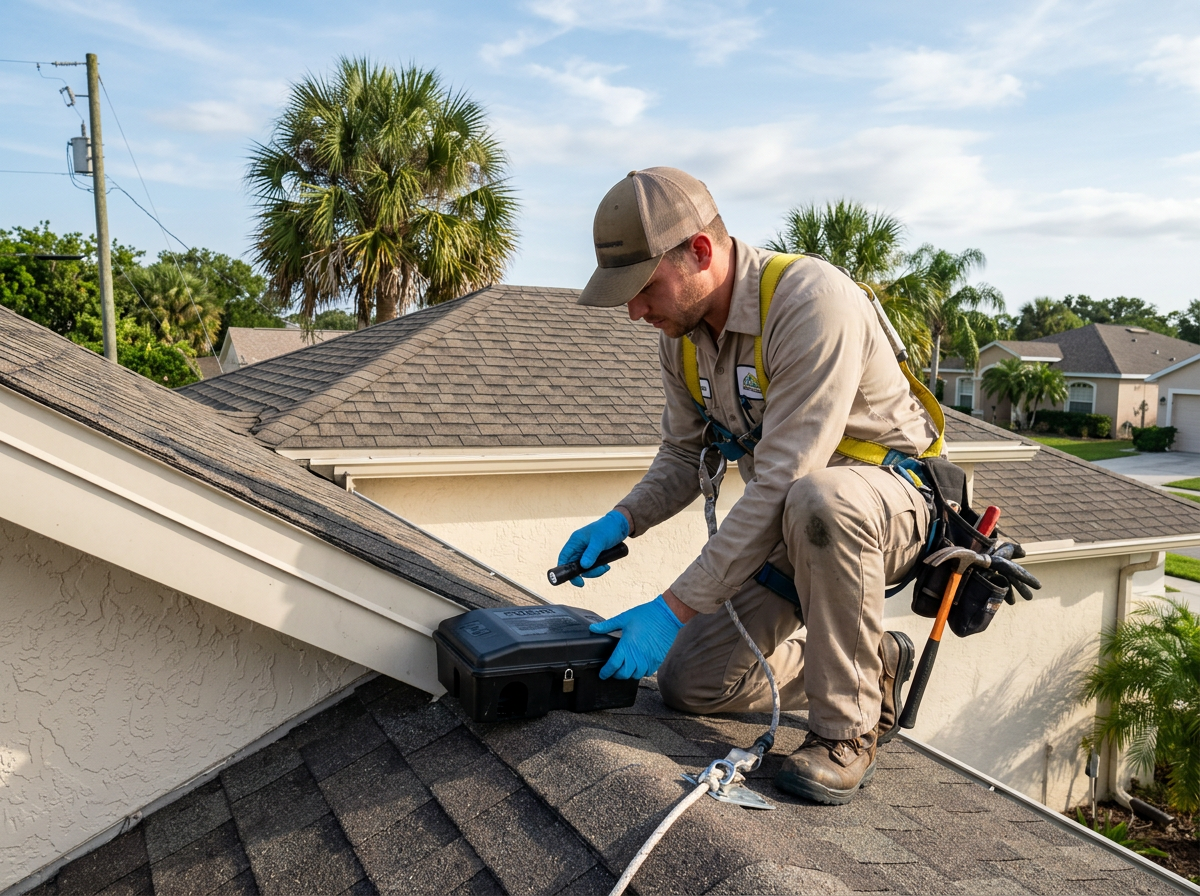
Roof rats in Bartow move along oak canopies and palm fronds that touch the roofline, then slip through soffit gaps, fascia openings, barrel tile voids, plumbing vent boots, gable vents, and AC line penetrations. Once inside they nest in attics where high heat turns any trapped or poisoned rat into an immediate odor source that travels through walls. Standard foundation sealing misses these routes entirely, so jobs that ignore the roofline fail within weeks as new rats arrive from neighboring properties.
Effective control starts with a full roofline inspection that checks every possible overhead access rather than ground-level gaps. Technicians seal soffits and fascia with steel mesh backed by sealant, install vent boot collars, and close tile voids with materials rodents cannot chew through. Interior trapping follows only after exclusion so that new rats do not replace those removed; follow-up visits confirm no fresh activity before closing the job.
Roof Rat Control Near You — Choose Your City
Every city below has its own local Roof Rat Control page with coverage details.
Polk
Volusia
Polk County
Levy
Alachua County
Marion County
Lake
Columbia County
Lee
Sumter
Alachua
Clay County
Nassau
Orange County
Brevard County
St. Johns
Lafayette
Collier County
Pasco County
Lake County
Putnam
Seminole
Volusia County
Gilchrist County
Hendry County
Citrus County
Monroe County
Marion
Highlands
Union County
Citrus
Pasco
Sumter County
Orange
Bradford
Suwannee County
Tree and palm trimming back from the roof is the single most reliable long-term step in central Florida because it breaks the travel routes that let roof rats reach the house. Without this step, even thorough sealing can be bypassed again within a season as branches regrow or neighboring trees lean closer. Attic insulation soiled by droppings and urine is assessed separately because removal is warranted only when contamination is heavy enough to affect air quality or when odors persist after the rats are gone.
Technician insight
In Bartow the thing that catches most people out with roof rat control is how fast new rats move in from the live oaks and sabal palms that line older neighborhoods. Houses built in the 1970s and 80s often have fascia boards that have pulled away just enough for a roof rat to slip under, and foam alone never holds because they chew straight through it. Trimming those trees back six to eight feet from the roofline stops the refill cycle that bait stations alone can never solve.
Bartow Roof Rat Job On A 1980s Home
Roof rats were entering through gaps under barrel tiles and a loose vent boot where palm fronds touched the roof. Inspection showed multiple soffit openings along the east side. Steel mesh collars and mesh-backed sealant were installed at every overhead point, interior traps removed the rats already inside, and the homeowner was advised to cut the palms back. No new activity appeared on the two follow-up visits.
Roof Rat Control Services We Offer
✓Roofline and Soffit Inspection
Technicians examine every soffit, fascia, vent, and roof penetration from above to locate the exact overhead routes roof rats use to reach the attic.
✓Barrel Tile and Vent Boot Sealing
Gaps under barrel tiles and around plumbing vent boots are closed with steel mesh and durable collars that prevent roof rats from dropping directly into the attic.
✓Attic Trapping Programme
Once overhead entries are sealed, targeted traps are placed in the attic to remove the roof rats already inside without relying on bait that fails in Florida's year-round climate.
✓Tree and Palm Clearance Advice
Specific trimming guidance is provided to cut oak branches and palm fronds back from the roofline so roof rats lose their overhead highway into the structure.
✓Follow-Up Verification
Return visits confirm that sealing holds and no new roof rat activity appears before the job is considered complete.
How it works
- 1
Full Roofline Inspection
Every soffit, fascia, vent boot, and tile void is checked from the exterior to map overhead entry points used by roof rats.
- 2
Overhead Exclusion Work
Steel mesh, hardware cloth, and vent collars are installed at identified gaps so new roof rats cannot enter from palms or oaks.
- 3
Interior Trapping
Traps are set inside the attic envelope to remove the roof rats already present after exclusion is complete.
- 4
Verification And Clearance
Follow-up inspections confirm no fresh activity and that odor sources from any dead rodents have been addressed.
Pricing
Scope depends on roof access, number of entry points found, and whether insulation removal is needed; call for an inspection-based quote.